Search this blog

Sunday, September 5, 2010

Marchionis, Tapered and Shouldered Blocks

I recently purchased two Machioni Tiltalls on EBay and noted that there was a design change at the "apex" block from a tapered "cone" section (left) to the permanent design that follows today - a much easier to machine squared shoulder.

For those interested in the headless monocolumn that I offer, the "shouldered" and assumed newer iteration (right) will accept the column, if the rather thickish inner bush strip is exchanged for a thinner bushing. The earlier lacks the bushing and I cannot recommend the expense of machining inorder to add a monocolumn.

No doubt there are even more earlier Marchioni design changes and if you have a curious version, I would be happy to post your jpegs and story.  Click on photo to enlarge.

Tuesday, March 30, 2010

Enhancements - Dave Anderson

Visit Dave Anderson's site for two Tiltall based innovations. Dave has recently (August 2010) blogged about his adventures with the Tiltall and the headless monocolumn.  Continuing his demonstration of what a innovative mind and a friendly machinist can create.

I am happy to post links to all other useful objects d' Tiltall.  I encourage Tiltall owners and designers to engage each other directly as my plate is overfull.

Monday, March 29, 2010

Enhancements or Detours

My own tinkering with Tiltall parts and pieces to create a video stablizer - any thoughts would be appreciated. Click on photo to enlarge.

Hopefully, this idea would not only smooth the tiny new HD cameras, but the offerings of the Nikon and Canon still/motion convergence as well.

Thursday, March 11, 2010

Gams without Jams

From Daniel Wong- Attached is a photo showing three (3) different versions of the leg lock
design on my own Tiltalls: Left:  Early model Leitz Tiltall tripod.  (best-working; all brass, similar to Marchioni); Middle:  Late model Leitz Tiltall monopod.  (better-working; brass and plastic); Right:  Star-D Tiltall tripod.  (cheaply designed; soft nylon.  Aluminum locking collar threaded onto an aluminum tube - a metallurgical no-no. Note that the nylon bushing has formed a small ridge as a result of repeated jams).

Mystery of the Star-D Tiltall


Following the Leitz purchase of the Marchioni company, what is the continuing ontogeny of Tiltall? My understanding is that Uniphot, an US export company, purchased Tiltall from Leitz hoping to export Tiltall to European and Asian markets, however Uniphot collapsed in the early '90s as did a number of other international photo trading groups such as Mamiya's Osawa in Japan, etc.  In 1998, Tiltall's current manufacturer, Oliver Yang, was asked by the folks that controlled some of the Uniphot holdings to continue Uniphot's Tiltall iteration and Oliver seems to have been true to that design to present.

Somewhere in the mix, we have the mysterious Star-D Tiltall. The Davidson Optronics Company was located (photo left) in West Covina, a suburb of Los Angeles. The Davidson Company still exists and made a number of interesting tripod designs during its history including the tripod shown above with the unique "Star-D" handle crank. According to numerous rumours, Davidson did not ever trade on the 'Tiltall" name (who knows, there may have been some partnership breakups between the Uniphot heirs).  But might have made some trademark sale of "Star D" to Fred Albu of Unifot.   To add to the confusion, some quite innovative tripod models do trade under the name "Tiltall" with no relation to the Marchioni design - many with quick release mechanisms and removable tripod heads  - see some of Adorama's Tiltall offerings.  [Ed: I thank Daniel Wong for the word "ontogeny".  UPDATE: current owner of the Tiltall mark, Oliver Yang, seems to add the name Tiltall to many other non-Marchioni designs.  Humbug!!]  Any corrections to this mythology are highly appreciated.

ADDENDUM March 12, 2010: Speaking today with Sam Bailey, of Davidson Optronics..  Sam started working for Davidson Mfg Company in 1963 and at that time, the Star-D tripod [left] had already been in production by Davidson since, he believes, the late 50's.  Sam says production ended in the late 60's, 1968 or so.  We may surmise, as the Marchioni Bros did not sell their concern to Leitz until 1974, that when the Star-D tripods by Davidson ended in the late 60s, some clever Davidson dealer, apparently Fred Albu, Camera Barn, NYC, and owner of the distribution company, Uniphot, was aware that the Star-D brand and logos might be available from the Davidson company.  [update: 2020.11.06 see various opinions following.  I have since purchased three of the original Davidson Star-Ds -gr]  

ADDENDUM : History detectives, thanks, Stan and Rolfe- November 26, 2002  Stan Yoder wrote:

I understood that the story went like this: when the Marchioni brothers(of NJ) died, the widows EACH sold the production rights, one to Leitz USA, the other to Davidson/Star-D, which at the time was an American firm. But that may be partly apocryphal. Leitz USA published a pamphlet on the Tiltall that states that it approached the brothers in 1973 about an "affiliation." The brothers then decided to retire from tripod production, Leitz moved their machinery to Rockleigh NJ, and the brothers trained the Leitz staff. It could be, then, that Leitz subsequently (what year?) sold the Tiltall to the entrepreneur who owned Star-D. OR, maybe the story is partially correct after all, and Davidson was producing its version concurrently (but after the bros. died?)

The Star-D could be had in at least two models, the better/best of which (the "Professional") had the brass collets in the leglocks, like the original. I own (and prize) one of these and the only difference I can detect is that the two tilt handles have black plastic grips rather than the aluminum knobs of the Marchioni bros. original. Otherwise, built like the proverbial brick s---house, and NOT lightweight. Sturdy is as sturdy does.

I dunno about the current Tiltall, having neither seen nor handled one. I've heard that it's not made like the older ones. "They don't build 'em like they useter, Horace!"

Can anyone shed conclusive light on this history?

The Star-D and the Leitz branded Tiltall were definitely produced
concurrently. The Star-D was cheaper, both in price and in fit and feel.
The current Tiltall seems to be somewhere in between, IMHO. I can't get the
legs tight enough on my modern Tiltall -- they want to screw right off the
head up at the top. Also, the redesign of the feet was certainly a
questionable one. On my Leitz, there is no way you are going to lose a foot
but on the modern tiltall, it only seems a matter of time before one comes
unscrewed without being noticed.

- --
Rolfe Tessem
Lucky Duck Productions, Inc.
rolfe (at)ldp.com
see http://mejac.palo-alto.ca.us/leica-users/

ADDENDUM- June 08 Note Asian Star-Ds in Comments below.  I am still hoping, as the California Star-D copy occurred during the Marchioni Bros lifetime, if the relationship was friendly or acrimonious? Perhaps a Marchioni Jr or Grand Jr would know.

ADDENDUM - June 09 On 4-Oct-2006, Bob Salomon - head of HP Marketing posted this on the Large Format Photography Forum.   I know Bob and consider him very knowledgeable in the history of the photo industry, but having spoken to an employee of Davidson (above), I cannot yet sort the following. Some of the internal logic is a bit bumpy: "Star D ended up being owned by Fred Albu who also owned Camera Barn a large camera store in NYC and the Uniphot distribution company who, among other products, was the distributor for Hoya.  Marchoni sold the Tiltall to Leica USA who manufactured it for a few years and then sold the Tiltall line to Star D who then sold two versions, the Titall and the Star D copy. (Ed: Davidson says they ceased manufacturing BEFORE Marchioni's sold to Leitz - above) Uniphot has been out of business for about 25 to 30 years. The Tiltall went off the market when Uniphot was closed. The tools and trademark were for sale by the Uniphot trustees and after a few years was purchased by the Chinese company that makes and sells it today. Under Uniphot several Star D tripods were sold and Star D also made tripods in the 50s as an independent company before Fred bought the company. There is no successor company to Uniphot or Star D and neither has existed for 25+ years so parts would have to be made. A replacement tripod would be more cost-effective then repairing."  Fred Albu is also mentioned in this history of Tiltall. which also mentions Omicron Electronics of Chatsworth which I believe is the missing link between Uniphot-Levitt's demise in the early 1980s and our current, Oliver Yang.

Monday, February 22, 2010

Marchioni Tiltall with detachable leg

Gary- You say in any earlier post that "If you own a Marchioni Tiltall with a 1/4-20 termination, let me know. The mythical belief is that the advent of the removable leg came with the 1/4-20 column base."  I have a Marchioni Tiltall, from late 1960s and it definitely has the removable leg. The original column cap fit it (to be a monopod), but I have since replaced it with your column which supports ballheads. I doubt this is new information, so I am a bit puzzled with your statement above. - Wayne Fulton
Wayne- Your are right, my statement is not at all clear.  With your Marchioni Tiltall - once the leg is removed from the Marchioni body, is there a "TEP-6" tripodie-type (1/4-20) base to then screw into top of this leg - or asked differently - how does your removable leg become a monopod. My Marchioni has no removable leg and only an open- ended stop at the bottom of the column. You have definitely squished the myth that the detachable leg came after Marchioni. - Gary

Gary- Oops!   Sorry, I cannot defend the monopod idea now...  I think you are correct.  I am glad you asked. The original center column had the screw-in stop on the bottom end of it, mine shown here (original column at bottom, reversed end to end).    That cap removes and will screw into the removed leg. However I discover that it is open ID and no monopod is possible, so there is no point of that.  There is a smooth one inch hole in it. I have never used the monopod, however it was always my notion that it provided one.  I am making this up now, but perhaps there was an accessory cap with 1/4" screw that did that?  My memory fails me now on this.    Anyway, it comes as a big surprise to me.    But why else would one leg unscrew? But my memory came from somewhere, and all these years, I have always "known" that one leg removed to be a monopod. I see no marking or distinction on the leg which removes, you have to find it.  Sometimes you have to use a little (reasonable) force to get it started loose, but no tools, bare hands only.  One leg will, and two will not, AFAIK.   I always assumed all Tiltalls did this. It is still a mighty fine tripod. -Wayne

Monday, February 15, 2010

Replacement Center Column Bush for Marchioni


From: Richard Karash, Feb 14, 2010

Hello Gary -- Following another blog post, I tried making a replacement for the paper/fiber bushing. A white/translucent Fuji 35mm film "can" looks just about right. Cutting a strip carefully to the right size, matching it to the existing fiber bushing. It's a great replacement for the paper/fiber bushing, perhaps a little thicker, which should help those who cannot lock the center column.

However, your headless column has a slightly larger diameter, so I have the opposite problem: I need a thinner bushing. After trying several approaches, drawing the plastic tightly over the sharp edge of a good scissors planes off a little at a time.  After a dozen strokes, I have a new plastic bushing that is just right...  I can slide the column up and down, but a moderate twist of the knob locks it down tight. Thanks for the excellent support of Tiltall. -Rick

Captions, photo above: Fuji 35mm film "can" has just about the right amount of plastic, right shape, and right thickness to replace the original Marchioni paper/fiber bushing Inset: Dark Marchioni paper/fiber bushing compared to my new plastic bushing from Fuji Film "can."  The white plastic is about the same thickness as the original, perhaps a little thicker. As is, it should help those with slipping center column.

Sunday, January 31, 2010

Cigars anyone??- new Tiltall Grandbaby

Oliver Yang, present manufacturer of the original Tiltall, has recently completed the design and first production of a direct descendant of the Marchioni Tiltall - in two versions, an aluminum tube and in a lighter carbon fiber tube, in two sizes. (Shown at left, larger carbon TC-284 with ball head BH-3, click on photo to enlarge.) Tiltall's grandbaby continues the reversable center column, removable leg cum monopod and spike/rubber leg tip, but adds a monoball head and three stop legs that folds over the ball head (see my earlier "dream" post) for a compact carry-on size.  Stats: Smaller carbon TC-254 closed: 42cm; extended: 142cm; weight: 1050g; Larger carbon TS-284 closed: 50.5cm; extend: 172cm; weight: 1430g; Smaller Alum TE-254 Closed: 42cm; Extend: 142cm; Weight: 1300g; Larger Alum TE-284 Closed: 50.5cm; Extend: 172cm; Weight: 1640g. Adorama is the first USA dealer - selling the smaller aluminum Tiltall Traveler TE-254 with smaller ball head BH-20 for $130.

Saturday, January 30, 2010

Learning curve - feet Two

The original Marchioni foot (left) had a descending spike through a fixed rubber tip.  The foot in current production follows  the opposite design - a fixed spike with a descending rubber tip - a change in design that I believe occurred with the Marchioni brothers before they sold the company to Leitz USA, but a design that certainly exists on the later Uniphot version and the StarD version.  If you own a late Marchioni, Leitz or StarD Tiltall, kindly submit a foot jpeg to correct this post and for the edification of your fellow aficionados.

Learning curve - feet

More notes from the field - The Uniphot (Woodside NY) foot (left) looks like it has very close to the same diameter post as the current production foot (right) and probably had/has a fixed spike/decending rubber (Note: Marchioni had decending spike/fixed rubber - see next post). But the Uniphot definitely has different threads - as per my order page, this is where the "may need a machinist" comes in - the ID of the last section of leg may need to be re-threaded. Or try to force things and/or copious amounts of epoxy for a very permanent solution. Alternatively, watch EBay for a Uniphoto Tiltall and cannibalize the parts as you need them.  (If you end up not using the current foot, please return ofcourse without paying.)  Photo and question from Jerome Crowder

Thursday, November 26, 2009

Tiltall aficiandos - Joe Farace


Irving Penn was not alone in his use of our "classic" Tiltall.  Here is writer/photographer, Joe Farace and his "fire engine" red and gold  Tiltall.  Dont ask! But it does help that Joe is a regular contributor to Shutterbug, Professional Photographer and has written more than 1600 magazine articles and 30 books on photo matters. [photo: Mary Farace]

If you have a photo of yourself with your Tiltall with a short bio, email it to me at garyregester(at)gmail.com and I will post it here.

Tuesday, November 10, 2009

Irving Penn - Tiltall photographer, dies at 92


NEW YORK, NY (AP).- Irving Penn, whose photographs revealed a taste for stark simplicity whether he was shooting celebrity portraits, fashion, still life or remote places of the world, died Wednesday, October 7, 2009 at his Manhattan home. He was 92. The death was announced by his photo assistant, Roger Krueger. Penn, who constantly explored the photographic medium and its boundaries, typically preferred to isolate his subjects — from fashion models to Aborigine tribesmen — from their natural settings to photograph them in a studio against a stark background. He believed the studio could most closely capture their true natures.

Between 1964 and 1971, he completed seven such projects, his subjects ranging from New Guinea mud men to San Francisco hippies.

Penn also had a fascination with still life and produced a dramatic range of images that challenged the traditional idea of beauty, giving dignity to such subjects as cigarette butts, decaying fruit and discarded clothing. A 1977 show at the Metropolitan Museum of Art presented prints of trash rescued from Manhattan streets and photographed, lovingly, against plain backgrounds.

"Photographing a cake can be art," he said at the 1953 opening of his studio, where he continued to produce commercial and gallery work into the 21st century. Penn's career began in the 1940s as a fashion photographer for Vogue, and he continued to contribute to the magazine for decades thereafter.

He stumbled into the job almost by accident, when he abandoned his early ambition to become a painter and took a position as a designer in the magazine's art department in 1943. Staff photographers balked at his unorthodox layout ideas, and a supervisor asked him to photograph a cover design.

The resulting image, on the Oct. 1, 1943, cover of Vogue, was a striking still-life showing a brown leather bag, a beige scarf, gloves, oranges and lemons arranged in the shape of a pyramid. More of AP article. . .

Ongoing Penn "Small Trades" exhibition at the Getty LA $50 show catalog here for ~$33.


Saturday, October 24, 2009

Travel tips and fantasies


Harold Sweet, of Samy's Camera Rental in Los Angeles, tells me that the Tiltall handles live in the center column during travel - easy with today's TEP6 base (A, right). Also works with the Leitz and Machioni "ring".   Then, just like they tell you on the aeroplane- "put your head between your legs" (B, right) and you will be a more successful Tiltall traveller.

[Don't forget to click on the photo to enlarge]

Now we enter the realm of wishful thinking - my lightly altered travel Tiltall (C, right) has three removable legs, actually three Tiltall four section Monopods.  This custom version is the same overall height extension as the standard Tiltall.  See the parts disassembled in the final frame (D). Note the formerly traditional Tiltall tripod head is now removable and tiny, only one pivot, not two - and three handles, not four.

What's so important as to shave off five inches (20 cm) from the length of a tripod?  At 21 inches, you can carry the Tiltall onboard the airplane under the 9x14x22 inch dimensioning rules for carry-on baggage.

Does this tripod exist? No and maybe - how many do you want?


Tuesday, October 13, 2009

Jammed Gams vs Toast

Dear Gary - I have a circa '74 Tiltall. It has been my primary camera support as a professional studio/location photographer (when not using a monopod studio stand) for over 35 years. It has been all over the world. It recently developed a problem with one of it's legs; it is jammed and extremely difficult to adjust. Obviously I am a huge fan and would like to repair this one and buy another. I am concerned that the years may have taken their toll on the precision that I count on with this amazing machine. -Tony / tonygaye.com

Tony- Let's try a repair/cleaning - first open up a working leg to get a "lay of the land" - with the original Marchioni and the Leitz, there will be coated brass fittings (ie bushings) - you may either have some grit in the jammed leg or your coating on the brass has worn off and starting to jam. 

The current solution is a nylon bushing which does not fit the earliest Tiltalls very well. You will probably find that if you reverse the brass bushing, add a little lube or exchange it with a different leg that you will get another 30 years out of the tripod.  Alternatively, watch for a good deal on EBay for a Tiltall of the same age and manufacturer and merge the two into one working tripod.  Now I do have a half dozen rebuilt KingHome Tiltalls available, but better to revive your classic.

Gary

Wednesday, September 30, 2009

Tiltall for the Birds


Pictured is a double length column (see headless column for monoballs) for use with spotting scopes and binoculars - or more exactly - an ardent bird watcher requested this extra long column for just such use. Why? Any of you birders let me know.

Tiltall Cork Pad by Malcolm Denemark


Malcolm Denemark, chief photog of Florida Today has re-invented the Marchioni cork top pads - I encourage you to contact Malcolm directly.  Here are Malcolm's installation instructions.

"Enclosed is a natural cork replacement pad for your Tiltall tripod. The Tiltall tripod is one of the best tripods ever manufactured. With care, it should last a lifetime. The one Achille’s heel of the Tiltall tripod is the platform pad. Time, heat, cold and years in hot car trunk can make the original rubber pad curl and come unglued.

"To remove the old pad: Peel off the pad. If there is glue residue on the platform top, clean it off with a scraper, a dab of Goo-Off or mineral spirits.

"To install the new pad: The Easy Way- use contact cement on the platform top and the cork. This will stick well, the only negative aspect to this method is that you cannot slide the pad around to position it correctly. The two parts will stick immediately. There is no adjusting the cork top. Be sure to face the curl down if you use this method and center the pad when you put it on the platform, starting with the hole centered on the screw and work outward.

"The Better Way: I have had the best luck with Gorilla Glue, and using a small piece of wood to clamp it with. I cut a small thin piece of wood at least 3 inches square and drill a ¼ inch hole in the center of the wood for the camera screw. The block of wood should be big enough to completely cover the metal tripod platform. I used a 1” x 4” making a 3 ½ inch square. (Do not drill a hole too much larger that the screw or you will get a bubble in the cork from not being clamped). Have clamps ready to go.

"Put a thin coat of Gorilla Glue on the metal tripod head. Spread it evenly, but do not get in on the center screw or the outer edge. Gorilla Glue expands. DO NOT use too much, and do not fill in the four holes for the set screws in the tripod head with glue. The excess glue will expand and put four lumps in your tripod pad!
I take a paper towel and wipe any glue off the metal platform near the very edge.

Position the cork pad. The pad has a natural curl to it. Place the cork with the curl down, so the center is up, the edges curl down. This will mean the cork is not fighting to curl up at the edges after it is glued.

"IMPORTANT! Wet the bottom side of the cork with water. The bottom is going to mate with the metal platform . The water activates the Gorilla Glue. This is how Gorilla Glue works. If you do not wet the cork, it will not work.

"Center the cork pad onto the platform. Be sure the hole is centered on the camera mounting screw. With Gorilla Glue you can slide it around to position the pad.

"Place the wood on top of the cork and clamp for an hour. After an hour check to be sure no excess glue oozed out and glued the wood block to the platform. Check to be sure your ¼ inch camera mount screw still spins and recesses. Reclamp for 24 hours.

"When dry I use a light spray of ArmorAll or similar product (an automotive product for dashboards and vinyl) to keep the cork moist. You can do this occasionally to keep the cork from drying out.

"Do not use Elmer’s Glue or white craft clue. Those glues work well on porous objects, not metal. Goo-off, Gorilla Glue, Elmer’s Glue and ArmorAll Protectant are all registered trade mark brand names."

Friday, April 24, 2009

TEP6 base vs Marchioni base


Note that present day Tiltall TEP6 base with 1/4-20 tripod screw (left) is a newer idea and different thread count than the original Marchioni column base termination. The addition of the tripod screw seems to have happened either with the later Uniphot version or with the Omicron folks. The idea no doubt occured with photographers using a Leitz, StarD or Uniphot Tiltall and adding a 1/4-20 bolt in the center of the solid end cap at the bottom of the column. (Marchioni has/had a "donut" end stop with a hollow center).

Thanks to Brian Wolfe, of Classic Cameras, Tehachapi, California for photo comparison. If you own a Marchioni Tiltall with a 1/4-20 termination (ie present TEP-6), let me know. The mythical belief is that the advent of the removable leg came at the same time as the 1/4-20 tripod threaded column base. Ed. note - see later post as this is not true - removable leg came long before TEP6 monopod idea - why?

Monday, January 26, 2009

Column Knobs Will Not Tighten


from Charles Hoot- "To say that I was wonderfully amazed to find you internet page for parts for the Tiltall would be an understatement! Just hope your service is still currently available.

"Great idea for replacing the column with a standard threaded one. But my lingering problem (that too is an understatement considering I purchased mine in about 1968) is locking the post in position - mainly vertically. Replacing the two knobs for the post with the new, broader style knobs might help to up the torque. Except that the real problem appears to be that the "paper/fiber" bushing material that guide the post in its sleeve does not seem to perform its contradictory job any more - it still promotes the sliding of the post, but not the gripping of it. At least that's my surmise. Do you have any suggestions? Do you sell the bushings? If not, do you know what readily available material could be substituted for it?"

Dear Charles - I don't presently have the bushing you need, nor am I certain that the bushings now made in Oliver Yang's production will work on all earlier Tiltall iterations until we get some current pieces out "into the field".

Here is the suggestion I have made many times and everyone says it works well- using your existing bushing as both a template and sample, visit a good plastics or hobby shop and look for a nylon, teflon or similar sheeting that you can use as a replacement - perhaps, now that you think about it you probably have a similar material lying around already - but the critical (and obvious) point is that the new "bushing" needs to be THICKER than the old one!! Use the old bushing to size the new one (ie "template") to proper size. You can see your quest in the exploded drawing below - part '024'.

There is a similar question about replacing the original tape at the bottom of the tube that the column slides through - this tape was to steady the column, not to lock it. A modern substitute that seems to work well is a strip of adhesive 'loop' velcro available from a sewing/fabric shop. Cut a strip long enough to go around the inner circumference.

NEW-  I have a  few of the current clear tripod "bushing" described above [01Oct09] for $4 w/postage.

Friday, January 23, 2009

Changing the Tripod Platform or 1/4-20 Tripod Screw


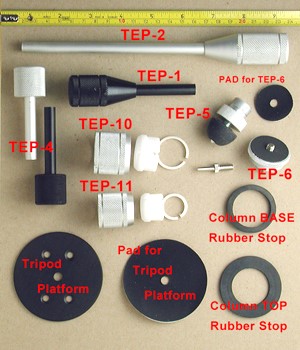
Several Tiltall photogs have bent their tripod platform or have somehow "altered" their tripod screw. Both can be changed - not easy, but not too difficult. You will need either a new platform (#1 above) or new threaded screw (#2 above), plus a new replacement rubber pad (#3, 3a above). We will also need a small Philips screw driver, a small Dremel tool and epoxy.

Remove the old rubber pad on top of your camera platform to expose four screw placements filled with resin. Remove resin with Dremel with appropriate grinding shape. Remove screws. Do not loose the spring that is about jump up and run off. Remove old tripod screw from knurled knob (#4 above) by carefully pressing it out of the knob. Replace with new thread, taking care that the fitting in the knurled knob is secure - a little epoxy might be in order here. Replace spring. Replace the tripod platform with four screws. Fill in the four divots with epoxy or similar. Apply new rubber pad to platform. Exploded drawing maybe useful to get a sense of the process.

I have tripod screw / knurl knob assemblies and will try to replace the above photo with better stepped photos.

All Tiltalls (do not) have a MonoPod


With the present production (KingHome) of Tiltall, one of the tripod legs is removable (#1 from #3 above), usually the tripod leg marked with the logo or label. Unscrew the small tripod "platform" (#2 above) (TEP6) at the bottom of the column. Screw TEP6 into the top of the leg and presto! whamo! a monopod for still or to stabilize video motion.  I believe this is true with the Uniphot and Star-D version, but (see next) it does not seem to be the case with Leitz and the original Marchioni design. 

New EDIT: Recent visit (Oct 09), by a Leitz Tiltall owner together the photo post above, seem to indicate that the TEP6 platform was a recent iteration - my guess is during the Star-D period as the Los Angeles company, Star-D added a whole number of "un-orthodox" "improvements" to Tiltall taken from innovations available on their other tripods (as example, a quick camera release).  The stop at the bottom of the Marchioni and Leitz versions, at least the older Leitz versions DO NOT accept the TEP6 platform.  Your comment can be added below.

Tiltall Explodes


Click on this photo to "explode" it even more.

Thursday, January 22, 2009

The Tiltall Preface - a brief history

This page now updated here. See comments below.

The Tiltall Preface:  Pushcart to Inventor -
Uncle Marchioni Makes Good

From http://www.zingersicecream.com/history.htm
      Italo Marchioni emigrated to the United States in the late 1800s, and although he lived in Hoboken, NJ for a time his fame resides solely in New York City. He began his business selling his homemade lemon ice from a single pushcart on Wall Street, but his business quickly grew into many carts.
      Although he was successful he still had a small problem that was causing him to lose money. At the time, most ice cream from vendors was sold in serving glasses called "penny licks" (because you'd lick the ice cream from the glass, and it cost a penny to do so).  There was a major problem with sanitation (or the lack thereof), but Marciony's problem was that many people would accidentally break the glasses, or not so accidentally walk off with them.  His first solution was to make cone-like containers out of paper which worked fine until he was hit with a stroke of genius. He came up with the idea of making an edible container for his cool treat.
So, in 1896 he began baking edible waffle cups with sloping sides and a flat bottom - shaped like his serving glass - and it was an instant hit.
     On September 22, 1903, he filed a patent application out of the city and state of New York, and U.S. Patent No. 746971 was issued to him on December 15, 1903. So although he lived in Hoboken for a time, while selling his wares in the big city, and although my home town web sites claims him as our own, his patent clearly states that he is "Italo Marciony of New York."
More details at the New Jersey Institute of Technology:

Brothers Marchioni Make Good
From Leitz Tiltall Tripod Story ca. 1975

     As time passed and the Marchioni business grew, the two brothers, Caesar and Mark began pursuing their own personal interests in their free time away from the store. Caesar had been given a camera in 1918 and he spent much of his time taking and developing pictures, while Mark’s interest led him to a specialty in industrial design.
     Until the start of the depression, the Marchioni Ice Cream business flourished but, as many businesses felt the pinch of the depression year the Marchioni brothers began to search for ways to augment their dwindling business and incomes. As Caesar turned more and more toward photography, he became frustrated with his tripod which while relatively steady, was heavy and since it didn’t feature a tilting head, limited him to straight-on photographs.
     Initially, Caesar and Mark turned their energies to developing a practical tripod head, one that would fit the cameras of the day and, most important, would allow the photographer to tilt the camera on the tripod and photograph his subjects from the best or more creative angles. They settled on a design, put what savings they had into a mini-machine shop and began manufacturing their unique product.
    Door-to-door sales of this new product didn’t break any records during the depression, but it kept the brothers busy, and began to develop into a modest business when the outbreak of World War II brought the business to a halt due to lack of materials. The brothers turned their skills to the war effort, and subcontracted to build precision tool parts for divisions of Bendix for the duration of the war.

The Tiltall Arrives

     After the war, the brothers decided the best thing they could do for their business was to produce the complete tripod, and not just the tiltable head. Tripods of the day could be divided into two main categories—the wooden ones, which were usually quite sturdy, but sometimes warped or dried and became brittle, or the metal tripods, which had a deserved flimsy reputation.
The two brothers began working on a design for a metal tripod: one that was solid, light, and could effectively maximize the versatile tilting head. In 1946, after considerable work, the first Tiltall was produced.

The Tiltall Tradition

From 1946 to 1973, the Tiltall production remained in the hands of the Marchioni brothers. Production was purposely limited to allow the brothers an opportunity to personally supervise and control all steps in the production cycle and assure a product of consistent quality. The files of the brothers are filled with letters of testimonial to the quality and superb performance of the Tiltall tripod demonstrating the success of this approach. Also, in spite of virtually no budget for advertising, Tiltall’s fame spread and the orders for new tripods far exceeded the brothers’ ability to produce them—even in the leanest years of our economy.

Tiltall and Leitz

Early in 1973, Gene Anderegg, from E. Leitz, Inc., in Rockleigh, New Jersey, who had known of the Tiltall for many years, contacted the Marchionis to discuss a possible affiliation. Leitz had an enviable reputation in the scientific world as the builder of the highest quality microscopes, and in the photographic world as the creator of the famous Leica 35mm system of photography.
The Marchionis felt that the time was right to retire and had been searching for someone to carry on the tradition they had established with such great care. The result, the Leitz reputation was enough proof for the Marchionis and a deal was consummated. And so, the tripod works were moved from Rutherford, New Jersey, to Rockleigh, New Jersey, where the Marchionis personally trained the staff now carrying on the work that began because a loving father gave his son a camera.  -here ends the Leitz' history.
Tiltall and Uniphot- ca.1985-2000  Star-D and Tiltall ca. 1985-2002   King Home and Tiltall - 2004 to Present
If you can add to or correct this history, please comment below